
Operate
Agents that work on their own
Wakes up, does the work, asks you when it matters
Give an agent a job and a time. It wakes up, works, splits the load when the job is big, and stops to ask you before anything you would want to check.
- Starts on a schedule, on an event, or on a button
- Splits big jobs across helpers that work in parallel
- Parks and asks a person, then carries on with the answer
- Shows what it did in plain language, not logs
We reply in under an hourOr message us on WhatsApp
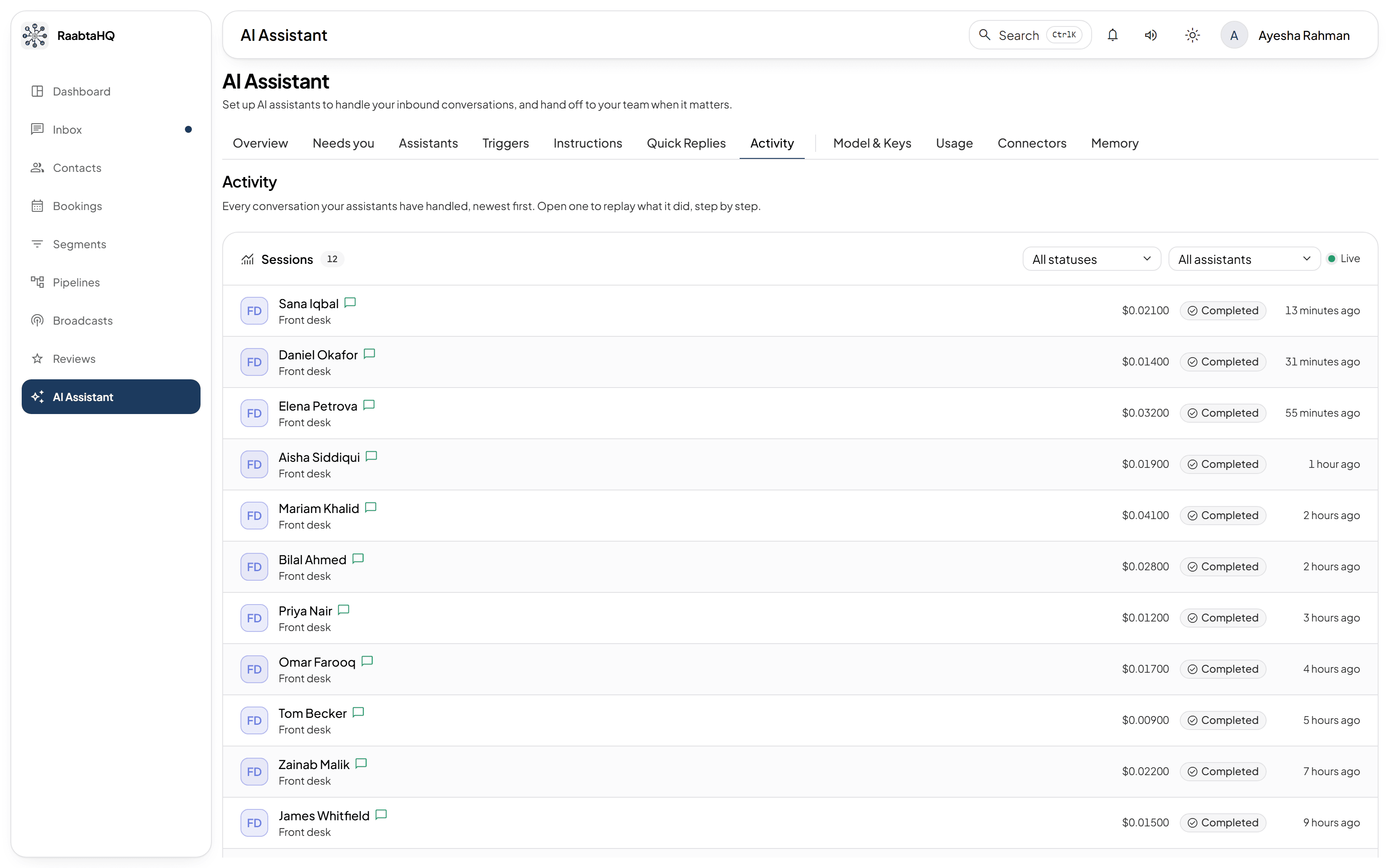
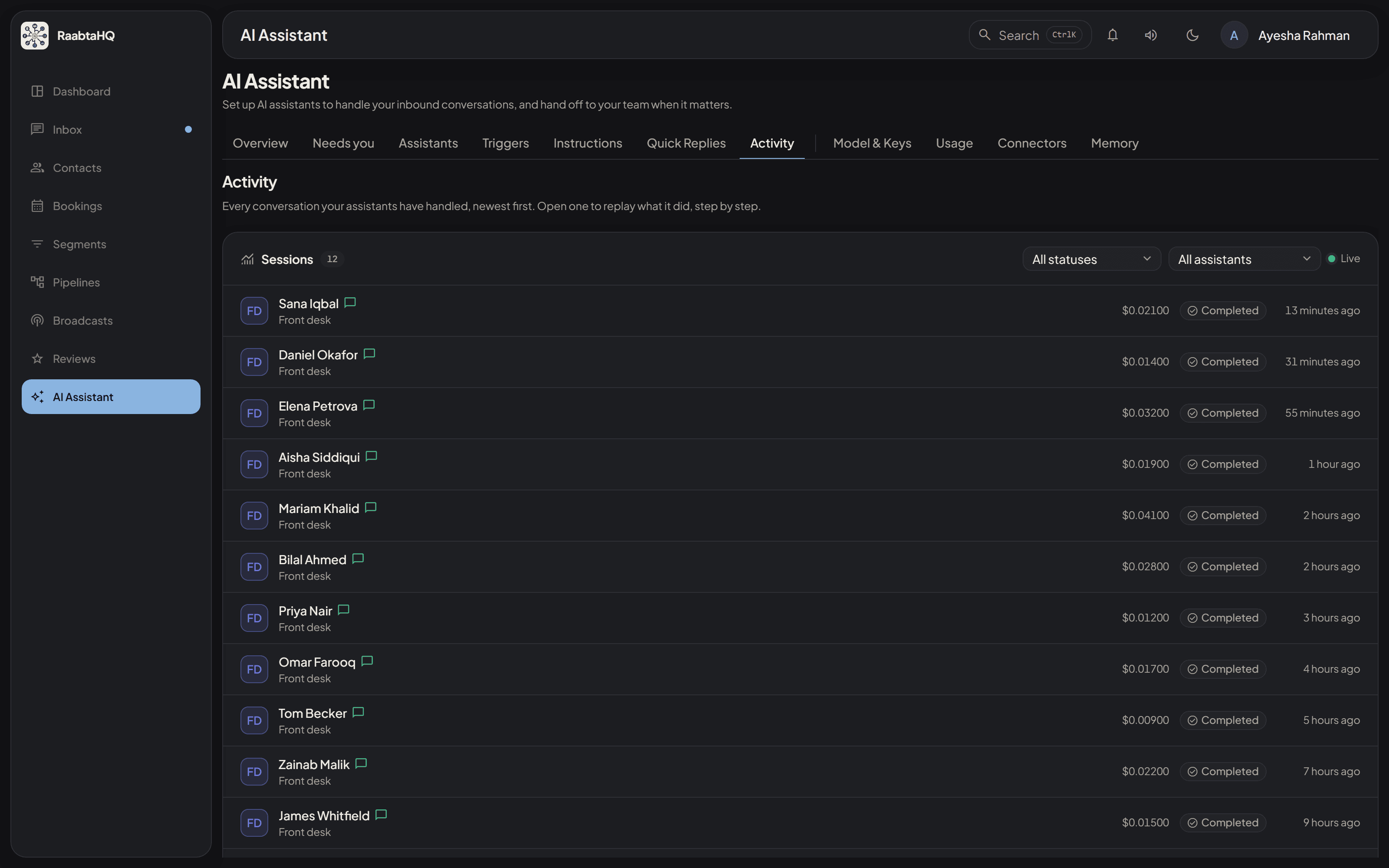
A screenshot of the running product. The names and numbers are invented; the software is not.
01 / 05
It no longer waits to be messaged
An agent used to need a customer to say something first. Now it can start every Monday at nine, or the moment a deal reaches a stage, a contact is created or a booking changes — or when you press a button. Nothing about the job has to involve a customer at all: reviewing last month’s ad spend is a perfectly good thing to give one.
- Recurring — daily, weekly, monthly, at a time you choose
- One-off — once, at a date and time
- On an event — a deal moves, a contact arrives, a booking changes
- By hand — a button, for the ones you want to watch
02 / 05
It stops and asks you, instead of guessing
When an agent hits something only a person can settle, it parks the job and puts the question in a queue — an approval, a choice between options it has already narrowed down, or a plain question. Answer it and the job carries on from exactly where it stopped, with your answer folded in. Every question carries a deadline and a stated fallback, so silence never gets read as approval.
- Approve, decline, choose one, or type an answer
- A live countdown, and a fallback you set in advance
- Who may answer depends on what is being asked
- Keyboard triage when the queue is busy
03 / 05
Big jobs get split across helpers
When a job has parts that do not depend on each other, the agent hands each part to a helper that works on it separately and reports back — all at the same time, rather than one after another. It decides what to split, at the time. There is no flowchart to draw and no boxes to connect.
- Helpers work in parallel, then hand their findings back
- Each helper gets only the tools it needs, never more
- Helpers never message customers — they cannot
- One spend limit covers the whole job, helpers included
04 / 05
And it tells you what it did, in words
Every run reads as a short story — “Asked you a question”, “Split the work into three pieces”, “Booked Tuesday at 2pm” — with no jargon and no log lines. The full technical trace is one click away when something needs debugging, but nobody has to read it to know what happened.
05 / 05
Nothing gets stuck, and nothing runs away
A job that waits too long gives up and carries on with what it has. A helper whose parent has finished is called off rather than left running. Costs are capped per run and across the whole account, and a run that crashes is picked up and retried rather than lost.
Explore more
Works well with
AI assistants
It drafts, it replies, it knows when to fetch a human
Draft replies and summarise threads, or hand whole conversations to an assistant that answers within limits you set — and steps aside the moment a person takes over.
Learn moreThe AI engine
Durable, resumable, and it never does a thing twice
What runs underneath the assistants — work written down before it happens, restarts that never repeat an action, and ceilings on time and spend it cannot talk its way past.
Learn moreBookings & scheduling
Take appointments without the back-and-forth
A team calendar, a public page customers book themselves, and confirmations and reminders that go out on their own.
Learn moreReady to answer every customer in one place?
Bring WhatsApp, Messenger and Instagram together with AI that actually helps. Talk to us and we'll get you set up.
We reply in under an hourOr message us on WhatsApp